> For the complete documentation index, see [llms.txt](https://developers.raycast.com/llms.txt). Markdown versions of documentation pages are available by appending `.md` to page URLs; this page is available as [Markdown](https://developers.raycast.com/information/developer-tools/templates.md).
# Templates
Learn about the templates provided by Raycast to help kickstart your extension.
Raycast provides a variety of templates to kickstart your extension.
Raycast provides 3 types of templates:
* **Commands:** These are templates for [commands](/information/terminology.md).
* **Tools:** These are templates for [tools](/information/terminology.md#tool). You can select a different one for each tool that you add to your extension.
* **Extension Boilerplates:** These are fully built extensions designed to be tweaked by organizations for internal use.
## Commands
### Show Detail
Renders a simple Hello World from a markdown string.

{% hint style="info" %}
See the [API Reference](/api-reference/user-interface/detail.md) for more information about customization.
{% endhint %}
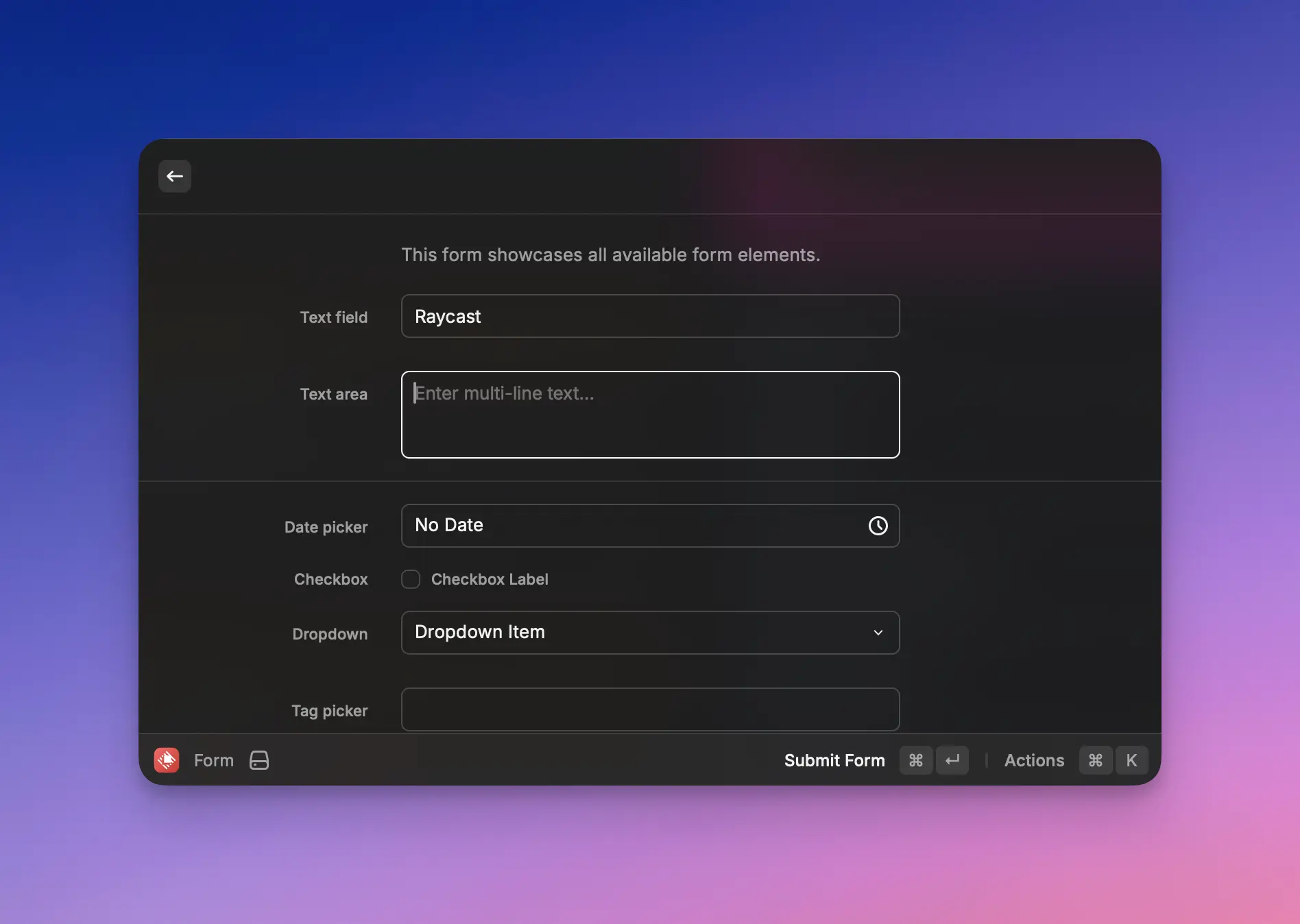
### Submit Form
Renders a form that showcases all available form elements.
{% hint style="info" %}
See the [API Reference](/api-reference/user-interface/form.md) for more information about customization.
{% endhint %}
### Show Grid
Renders a grid of Icons available from Raycast.
Defaults to a large grid, but provides a selection menu to change the size.

{% hint style="info" %}
See the [API Reference](/api-reference/user-interface/grid.md) for more information about customization.
See here for information about [Icons](/api-reference/user-interface/icons-and-images.md).
{% endhint %}
### Show List and Detail
Renders a list of options. When an option is selected, a Detail view is displayed.

{% hint style="info" %}
See the [API Reference](/api-reference/user-interface/list.md) for more information about customization.
{% endhint %}
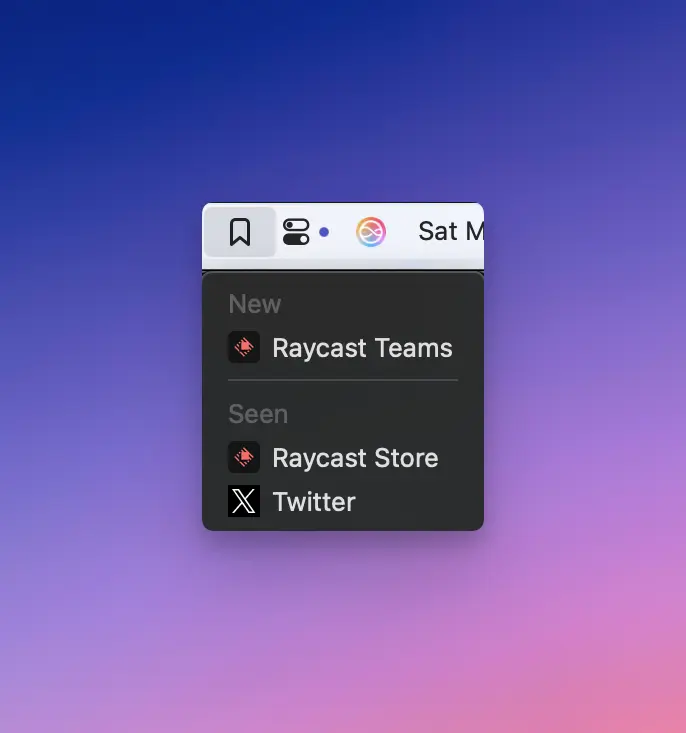
### Menu Bar Extra
Adds a simple Menu Bar Extra with a menu.
{% hint style="info" %}
See the [API Reference](/api-reference/menu-bar-commands.md) for more information about customization.
{% endhint %}
### Run Script
A example of a no-view command which shows a simple [HUD](/api-reference/feedback/hud.md).
### Show List
Renders a static list with each entry containing an icon, title, subtitle, and accessory.

{% hint style="info" %}
See the [API Reference](/api-reference/user-interface/list.md) for more information about customization.
{% endhint %}
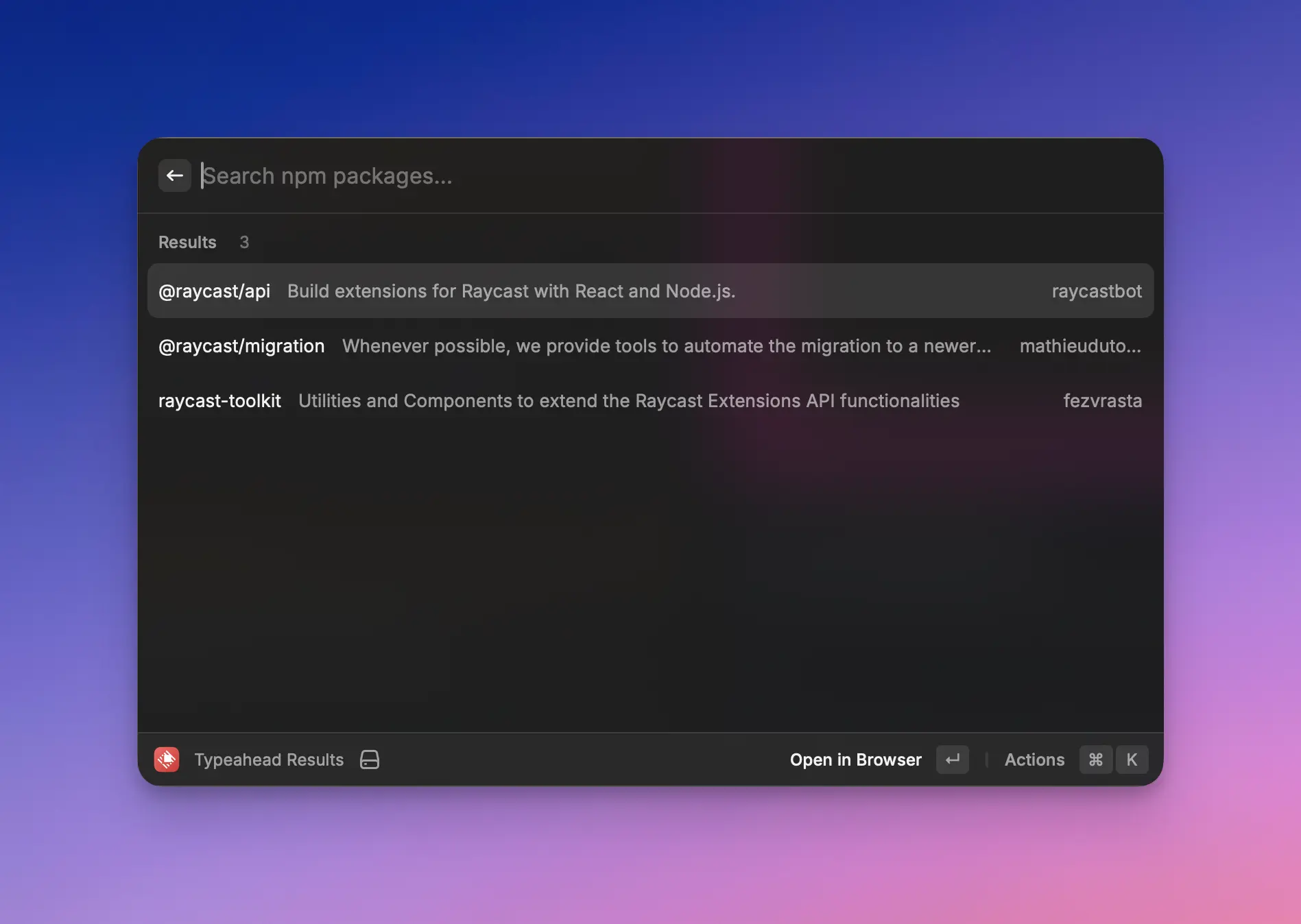
### Show Typeahead Results
Renders a dynamic and searchable list of NPM packages. The command fetches new items as the search is updated by the user.
### AI
Renders the output of an AI call in a Detail view.

## Tools
A simple tool which asks for confirmation before executing.

{% hint style="info" %}
See the [API Reference](/api-reference/tool.md) for more information about customization.
{% endhint %}
## Extension Boilerplates
The Raycast Team has created high-quality templates to reinforce team experiences with the Raycast API.
Run `npm init raycast-extension -t ` to get started with these extensions. All templates can be found on the [templates page](https://www.raycast.com/templates).
Specific instructions about customizing the template can be found on the relevant [template page](https://www.raycast.com/templates). Simply customize the template as you see fit, then run `npm run publish` in the extension directory to allow your team to install the extension.
---
# Agent Instructions
This documentation is published with GitBook. GitBook is the documentation platform designed so that both humans and AI agents can read, navigate, and reason over technical content effectively. Learn more at gitbook.com.
## Querying This Documentation
If you need additional information that is not directly available in this page, you can query the documentation by asking a question.
Perform an HTTP GET request on the following URL with the `ask` and `goal` query parameters:
```
GET https://developers.raycast.com/information/developer-tools/templates.md?ask=&goal=
```
`ask` is the immediate question: it should be specific, self-contained, and written in natural language.
`goal` is what the user is ultimately trying to achieve, the reason they need the answer. Sharing it helps GitBook give you a better, more relevant answer. A goal is most helpful when it describes the outcome the user wants rather than restating the question. For example, with `ask=how do I create an API token`, a goal like `automate deployments from our CI pipeline` lets GitBook tailor the answer to that use case.
The response will contain a direct answer to the question and relevant excerpts and sources from the documentation.
Use this mechanism when the answer is not explicitly present in the current page, you need clarification or additional context, or you want to retrieve related documentation sections.